Friday, April 8, 2016

Digital Scholarly Editions as Interfaces

'd like to remind you that the deadline for submissions for „Digital Scholarly Editions as Interfaces“ – a two days symposium at the Centre for Information Modelling at Graz University (23.-24.9.2016) – is approaching. The symposium will explore the role of digital scholarly editions as interfaces between humans, machines and manuscripts from different perspectives (editors, users of editions, interface designers, developers etc). Keynotes speakers are Dot Porter (Kislak Center for Special Collections, Rare Books and Manuscripts, Univ. of Pennsylvania) and Stan Ruecker (Institute of Design at Illinois Institute of Technology, Chicago). For more information see the call for papers:https://informationsmodellierung.uni-graz.at/de/aktuelles/digital-scholarly-editions-as-interfaces/

We invite you to submit proposals for a talk (20 minutes; < 700 words) until April 17, 2016 to dixit(at)uni-graz.at.
Call for Papers MEMSA CONFERENCE 14-15 JULY 2016 

MEMSA is pleased to announce its tenth annual conference on the theme of Identifying Identity: Ideas of Personal and Public Identity in the Medieval and Early Modern World. 

This interdisciplinary conference will invite postgraduate and early career researchers to speak on all aspects of identity. We welcome papers from all disciplines studying identity in the medieval and early modern world. Identity is an increasingly important subject in academic research that transcends interdisciplinary boundaries. Identity and the methodologies we use to find and communicate evidence of identity in literary, historical, archaeological and other sources are relevant to both our own lives today, as well as the medieval and early modern world we study. 

Suggestions for topics include, but are not limited to:  Performed identities  Transnational identity and conflict  National and local, macro and micro-identities  Ownership, artistry and patronage in private and public buildings  Mistaken identity and deception  Authorship and attributions in texts  Gender and sexual identities  Imagined community  Urban and rural identities  Identification with literary figures  Medieval and early modern ideas of the self  Religious identities  Kinship, community and neighbourhood  Expressions of identity in ego-documents 

In addition to the panels the conference will include two key note lectures by Prof Andrew Beresford (Durham University) and Dr Fiona Edmonds (University of Cambridge) and opportunities for delegates to visit Durham Cathedral and Castle. The conference fee will be £10, which will cover costs for refreshments and lunch. 

Papers should be 15-20 minutes long and will be followed by time for questions and discussion. Abstracts of 200-300 words can be sent to imrs.memsa@durham.ac.uk. The deadline for the submission of abstracts is 10 April 2016.

For more information and updates, visit dur.ac.uk/imems/memsa, our blog durhammemsa.wordpress.com, and follow us on twitter @DurhamMEMSA

Thursday, April 7, 2016

Midwest Medieval History Conference
Call for Papers

October 21 and 22, 2016
Middle Tennessee State University, Murfreesboro, TN

Keynote speaker: Thomas Burman, PhD.

The Midwest Medieval History Conference is seeking papers for its annual conference. We welcome papers addressing any aspect of the Middle Ages, particularly papers on this year’s topic, the Medieval Mediterranean. Graduate student papers are welcome for the Friday afternoon sessions, which are dedicated to graduate student research. We also invite papers on the scholarship of learning and on practical approaches to teaching.

Submission deadline: June 15, 2016.

Submit abstracts for paper proposals to Paula Rieder at paula.rieder@sru.edu

http://msrg.blogs.lincoln.ac.uk/files/2014/08/Genova-medievale.jpg

Monday, April 4, 2016


The Viking Age was a period of profound changes and global impact: from the expansion across the Atlantic to the extension of trade routes to the east. It is fair to say that England was forged in response to Viking activity and even today ‘Vikings’ seem to elicit much response in popular culture. In a year that sees the anniversary of the first Scandinavian king on the English throne in 1016 and the 950th anniversary of the Norman Conquest it seems pertinent to look at the Viking World in all its different facets. We are therefore very pleased to announce the conference programme for 'The Viking World: Diversity and Change' which will take place at Nottingham from 27th June to 2nd July 2016:
https://www.nottingham.ac.uk/conference/fac-arts/english/viking-world/documents/viking-world-2016-timetable-final.pdf

 Papers cover a range of topics and disciplines: from the Eastern expansion to North Atlantic colonies, language, place-names and literature, archaeology, runology, mythology and modern perceptions.

Please visit the Conference website at: https://www.nottingham.ac.uk/conference/fac-arts/english/viking-world/index.aspx

Sunday, April 3, 2016

Medieval in This Week's News

James Robinson has died--Medievalists would know him as the editor and translator of the Nag Hammadi Library


Another Bit on the new North American Viking site--also advertising for a BBC documentary to air tomorrow, April 4 for those who have access.


Bones of St. Erik that have been in the news of late are likely authentic


A reconsideration of King John


Dig at Lochore in Fife shows habitation in early medieval period


A metal "rope" found in 2014 now thought to have been a monastic flagellant


The Search for Henry I Begins


Kashmir has first female leader since medieval period 


Medieval Kitchen Uncovered at Bury St. Edmunds


Medieval Castle to host St. George's Day Celebrations at Dudley


Medieval Wall Painting in Suffolk Vandalized


A Feature on St. Martin's in Colchester


Movie To Be Done in Old Norwegian


Archaeology at Chateau de Clissons


TEMA CFP

Proposals on all topics in medieval studies are invited for TEMA 2016. Abstracts of individual papers and sets of abstracts for full sessions are equally welcome.
We especially hope to attract papers and panels contributing to the 2016 conference theme: in shorthand, –form–, but invoking any word sharing this root. The numerous –form– terms, though divergent in meaning, all pertain to organization, configuration, or structured relations. Virtually any topic in any discipline can be viewed through its engagement with these concepts. Those who wish to connect to the conference theme may seek intersections of their areas of interest with ideas of transformation, information, conformity/non-conformity, performance, formulation, reformation, or any other component of the far-reaching –form– network.
Papers may be delivered in English or Spanish. If the presentation language will be Spanish, please specify this. Send abstracts (in English) of approximately 200 words to Britt Mize (bmize@tamu.edu) no later than August 1, 2016. Early submission is encouraged: rolling acceptance will begin on May 31, 2016, and space may become limited after this date. Among proposals for full sessions, those including participants from more than one institution will be given priority. A prize will be awarded for the best paper by a graduate student (learn more).

Defining Paganism: Processes of Christianisation in the Early Middle Ages – A workshop

AN00098117_001_l
The Franks Casket (front) © British Museum
13 May 2016 |14.00-18.00 |University of Utrecht, Drift 6 room 0.07
This workshop discusses the processes of Christianisation in the Early Middle Ages. The focus shall be on concepts of ‘paganism’ as employed in these processes. This should provide a basis to discuss what can be known about ‘pagan religions’ in this period in order to develop further methodological and theoretical reflexions on the topic.
Each participant will give a short presentation (max. 20 minutes) based on his or her own research. Scholars of different levels will contribute to the workshop – from senior researchers to master students. Plenty of time will be reserved for debate, as it is the aim of this workshop to exchange perspectives. The workshop is open to all.
To stimulate debate the following reading material is recommended:
James Palmer, ‘Defining Paganism in the Carolingian  World’, Early Medieval Europe, 15, 4 (2007), 402–425.
Please access this  title in your local library or, if unavailable, write to e.pereirafarrell@uu.nl.
Picture1
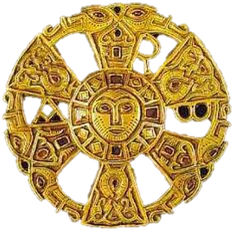
The Golden disc from Limons
© Paris, Bibliothèque Nationale
PROGRAMME (Workshop_Paganism_PDF):
14:00-14:20  ‘Christianity and paganism: some preliminary thoughts’, Rob Meens (UU)
14:20-14:40   ‘Who are the pagans? Religious problems and Christian idealisations in  Adam of Bremen’s Gesta Hammaburgensis’, Lukas Grzybowski (USP; FAPESP)
14:40-15:00   ‘Regulating “Paganism” in the Penitentials?’, Elaine Pereira Farrell (IRC; UU; UCD)
15:00-15:30   Master Students’ presentations (UU): Nina Crowther, Birgit ter Horst, Annemarie Veenstra
15:30-15:50    Discussions
15:50-16:10    Coffee Break
16:10-16:30   ‘Some perspectives on reconstructing the pre-Christian religion of the Frisians’,  Han Nijdam (Fryske Akademie)
16:30-16:50   ‘More questions than answers: the (lack of) evidence for religion in Merovingian archaeology’, Martine van Haperen (UL)
16:50-17:10   ‘Why early medieval prognostics are no “pagan relics”’, Carine van Rhijn (UU)
17:10-17:30    Discussions
17:30-18:00    Final Remarks, Roy Flechner (UCD) & Marco Mostert (UU)